
NEWS UPDATE

Multiple airlines and aircraft accident teams join Flight Data X at the Malaysian Aviation Academy in Kuala Lumpur Malaysia

Together with the esteemed Malaysian Aircraft Accident Investigation Team and Bhutan Aircraft Accident Investigation Unit, we proudly hosted a dynamic cohort of aviation professionals, including eight first-time participants from Biman Bangladesh Airlines, alongside returning delegates from AirAsia and Hornbill Skyways. This diverse group didn’t just attend—they fully immersed themselves. Beyond completing our foundational CVA 101 and FDA 101 programs, many participants accelerated their expertise by advancing into FDA 201 (Intermediate Flight Data Analysis) and tackling the rigor of our intensive five-day CVA 201 Intermediate Cockpit Voice Data Analysis course—demonstrating a commitment that truly sets them apart.

The atmosphere throughout the program was electric—driven by curiosity, collaboration, and a shared passion for aviation safety and innovation. Guided by some of the industry’s most accomplished flight data specialists, participants engaged hands-on with real-world scenarios, solving complex operational challenges in real time. This wasn’t just training; it was transformation. Graduates left not only with globally recognized certifications, but with sharpened analytical capabilities and the confidence to make immediate impact within their organizations.

We proudly commend every participant for rising to the challenge and thriving in this high-performance training environment. Your dedication and resilience have laid the groundwork for leadership in flight data analytics and aircraft accident investigation. We look forward to seeing each of you elevate safety standards and drive meaningful change across the global aviation industry.

I failed my annual FDR readout for my helicopter due to a missing rotor speed. How can I address this?

First make sure the signal/sensor output is available on your helicopter. Next, upgrade your CVR to a model which has rotor speed capability. If you require certification assistance, we can help.

I need to synchronize my FDR and CVR data due to an aircraft incident we just had. How can I go about this?

Locate the sample where your FDR radio altitude reached 50 foot (+/-) on approach and match that up with your CVR audio callout at 50 feet. Next, create a chart correlating the audio time to your GMT time based on the initial 50 foot synchronization you have established. If you find this difficult, you can also attend our CVA 101 course where we teach students how to synchronize CVR and FDR data.

Learn more about how Flight Data Simulation can benefit your organization.

Learn more about how Flight Data Simulation can benefit your organization.

Learn more about how DAE for Aerospace can benefit your organization

How do I modify my FDR to record more than 25 hours?

You can modify the program pins at the rear of the SSFDR to uptick your recording hours. For example, if you have a Honeywell PN 980-4700-XXX installed, you can alter the ‘ground/open’ discrete wiring at pin 17 & 18 of the SSFDR mating connector to increase your recording capacity.

How can I determine the amount of hours recorded by my FDR?

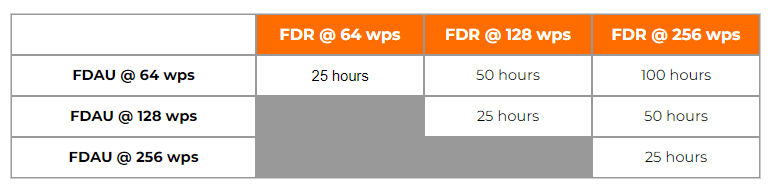
The amount of recorded hours is dependent on a combination of your FDAU wps output and FDR maximum allowable recording speed. If there is a one to one relationship between the two units, i.e. – 64 wps FDAU with a 64 wps FDR, you will record the last 25 hours of flight data. This also applies to the case when the FDAU and FDR are both 128wps, 256wps, or even higher. If there is a mismatch between the FDAU and FDR speed, a small and simple calculation can be made to determine actual flight hour recording capacity. See the figure below for the various possibilities:

How can I determine the speed of my Flight Data Recording system in words per second (wps)?

There are basically 4 ways to determine your speed, with the 4th being a bit more involved. First, the speed should be listed or documented in chapter 31 of your aircraft Maintenance Manual and/or Wiring Diagram Manual. However there are times when for some reason, the required information cannot be found. If this is the case, as a second method, you may reference the CMM or technical specification for your Flight Data Acquisition Unit (FDAU). If you are still unable to find this information, you may contact the aircraft manufacturer for the wps or review your previous FDR download analysis reports. Please keep in mind, the OEM will only know the as-delivered configuration of your aircraft. If there were modifications to your aircraft post-delivery – manufacturer unaware of the changes – youll need to contact us for an analysis of your raw data. Using our software we can determine the wps of your system.

With regard to Flight Data Recorder Systems, what exactly does wps imply? I have noticed this abbreviation in our FDR documentation and in communications with the manufacturer several times:

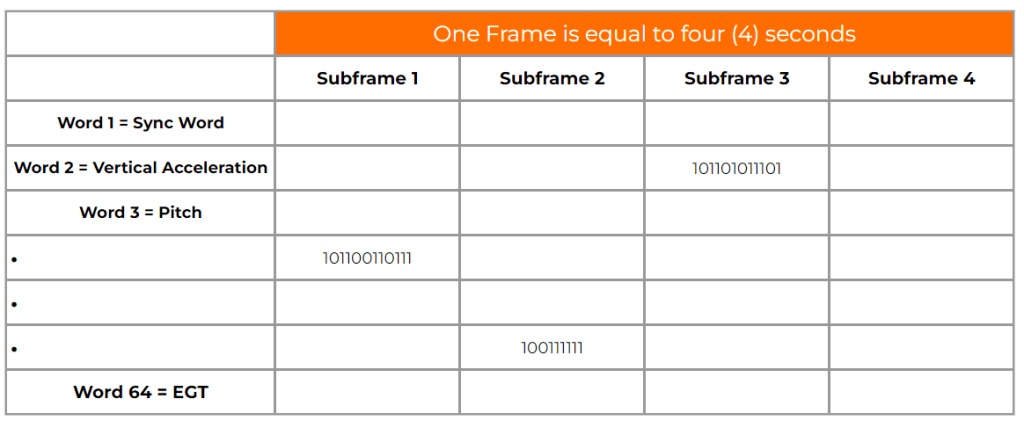
WPS = words per second. A word (12-bits in length) contains binary data which represents a specific parameter value. Please see figure 1 below. Your FDR records in frames (4 second intervals) and each frame contains 4 sub frames (one sub frame = 1 second). With each second that goes by a specific quantity of words are recorded into memory. If you operate a 64 wps FDR system, you will record 64 12-bit words in one second. The higher the word capacity the more information you can record.

What is a Dataframe Layout (DFL)?

A DFL, also known by the name Logical Frame Layout (LFL), Dataframe Interface Control & Requirements Document, and many other names depending on the manufacturer, is a document which specifies the FDR, QAR, or DAR Parameter Word (location), Recording Speed, Sampling Rate, Bits, and Conversion formulae for your recording system.  

Contact our Team

Contact our Team