
Aircraft Incident Investigation

Airplane to land

Events lead to Incidents, and Incidents lead to Accidents

The Reality:

Runway excursions/incursions, TCAS RA’s, near misses, in-flight engine shutdowns, CFIT, hard landings, flap overspeeds, and rejected takeoff’s are just a few reasons why you need to have a ‘24/7’ 365 days-a-week support team on standby, to assist with the investigation process. In any aircraft or airline operation, the ability to quickly determine the root cause of events, incidents, and exceedances, can not only improve safety, but it can also help you avoid costly maintenance inspections, repetitive aircraft damage, and reduce the risk of abnormal operations. Recorded data, whether from your FDR, QAR, DAR, or CVR, needs to be analyzed as soon as possible after the incident before the event details begin to fade.

The Solution:

At the Flight Data X analytics and operations center, we are on call to support your analysis needs any time of the day, up to and including Holidays. With support centers and satellite offices in the U.S.A, Middle East, and Asia, our response time to your queries is reduced to minutes. Regardless of your time zone and location, we are prepared to analyze and provide accurate root cause analysis, especially when your incidents and events catch you off guard or during off hours.

Prepare Now :

We can’t do magic. In order for us to respond to your incident promptly, we’ll need all of your data in advance. Access to your manuals, knowledge of your aircraft configuration, storage of your recorder data set, and familiarization with your routes will assist us in providing you with real time support.

The International Civil Aviation Organization (ICAO) defines an aircraft incident as an occurrence that affects or could affect the safety of aircraft operations, but is not an accident. Incidents are different from accidents because they do not meet the thresholds for personal injury or aircraft damage set out in the National Transportation Safety Board's (NTSB) definition of an accident.  ICAO uses occurrence categories to classify incidents and accidents at a high level, which helps analyze data to support safety initiatives. Some examples of these categories include "loss of control" and CFIT.  States are not required by ICAO to investigate incidents, but Annex 13, paragraph 7.7 recommends reporting incidents involving aircraft over 5,700 kg if the investigation reveals matters of interest to other states. If a state determines that an incident is significant enough to warrant an investigation, they can send an Incident Data Report to ICAO ADREP.
Event Analysis Using FDR Data

Begin by gaining a comprehensive understanding of the process and importance of event analysis using FDR data.

Graphical Plot & Tabular Data

Explore the visual and tabular representations of flight data, gaining the skills to analyze and interpret these data formats.

Flight Visualization (e.g., Google Earth)

Learn how to leverage flight visualization tools, including Google Earth, to enhance your event analysis capabilities.

Final Exam

Test your knowledge and skills in event analysis using FDR data through a comprehensive final exam. Successful completion of the exam will validate your expertise in this specialized field and earn you a certificate of achievement.
I failed my annual FDR readout for my helicopter due to a missing rotor speed. How can I address this?

First make sure the signal/sensor output is available on your helicopter. Next, upgrade your CVR to a model which has rotor speed capability. If you require certification assistance, we can help.

I need to synchronize my FDR and CVR data due to an aircraft incident we just had. How can I go about this?

Locate the sample where your FDR radio altitude reached 50 foot (+/-) on approach and match that up with your CVR audio callout at 50 feet. Next, create a chart correlating the audio time to your GMT time based on the initial 50 foot synchronization you have established. If you find this difficult, you can also attend our CVA 101 course where we teach students how to synchronize CVR and FDR data.

Learn more about how Flight Data Simulation can benefit your organization.

Learn more about how Flight Data Simulation can benefit your organization.

Learn more about how DAE for Aerospace can benefit your organization

How do I modify my FDR to record more than 25 hours?

You can modify the program pins at the rear of the SSFDR to uptick your recording hours. For example, if you have a Honeywell PN 980-4700-XXX installed, you can alter the ‘ground/open’ discrete wiring at pin 17 & 18 of the SSFDR mating connector to increase your recording capacity.

How can I determine the amount of hours recorded by my FDR?

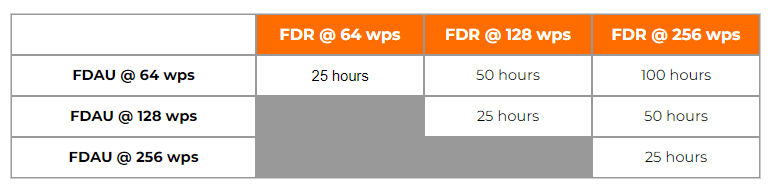
The amount of recorded hours is dependent on a combination of your FDAU wps output and FDR maximum allowable recording speed. If there is a one to one relationship between the two units, i.e. – 64 wps FDAU with a 64 wps FDR, you will record the last 25 hours of flight data. This also applies to the case when the FDAU and FDR are both 128wps, 256wps, or even higher. If there is a mismatch between the FDAU and FDR speed, a small and simple calculation can be made to determine actual flight hour recording capacity. See the figure below for the various possibilities:

How can I determine the speed of my Flight Data Recording system in words per second (wps)?

There are basically 4 ways to determine your speed, with the 4th being a bit more involved. First, the speed should be listed or documented in chapter 31 of your aircraft Maintenance Manual and/or Wiring Diagram Manual. However there are times when for some reason, the required information cannot be found. If this is the case, as a second method, you may reference the CMM or technical specification for your Flight Data Acquisition Unit (FDAU). If you are still unable to find this information, you may contact the aircraft manufacturer for the wps or review your previous FDR download analysis reports. Please keep in mind, the OEM will only know the as-delivered configuration of your aircraft. If there were modifications to your aircraft post-delivery – manufacturer unaware of the changes – youll need to contact us for an analysis of your raw data. Using our software we can determine the wps of your system.

With regard to Flight Data Recorder Systems, what exactly does wps imply? I have noticed this abbreviation in our FDR documentation and in communications with the manufacturer several times:

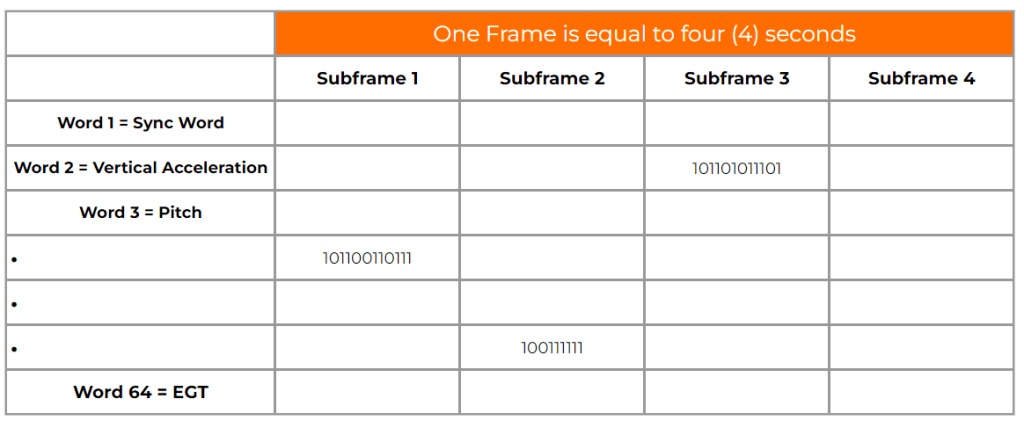
WPS = words per second. A word (12-bits in length) contains binary data which represents a specific parameter value. Please see figure 1 below. Your FDR records in frames (4 second intervals) and each frame contains 4 sub frames (one sub frame = 1 second). With each second that goes by a specific quantity of words are recorded into memory. If you operate a 64 wps FDR system, you will record 64 12-bit words in one second. The higher the word capacity the more information you can record.

What is a Dataframe Layout (DFL)?

A DFL, also known by the name Logical Frame Layout (LFL), Dataframe Interface Control & Requirements Document, and many other names depending on the manufacturer, is a document which specifies the FDR, QAR, or DAR Parameter Word (location), Recording Speed, Sampling Rate, Bits, and Conversion formulae for your recording system.  

Contact our Team

Contact our Team